by George Fallar
In a nationally televised address on December 17, 2025, the president announced a tax-free $1,776 “Warrior Dividend” to be paid to approximately 1.45 million active-duty and reserve component service members. The symbolism was deliberate, the timing unmistakable, and the applause line predictable. Few Americans object to rewarding military service, particularly at the holidays. But the manner in which this bonus was explained to the public deserves far more scrutiny than it has received.
The president attributed the funding for the dividend to “surplus tariff revenue,” suggesting the money was essentially a windfall generated from foreign exporters. That implication is false. While it is true that 1.28 million Active Component members and roughly 174,000 Reserve Component members are receiving the payment—and soldiers have already confirmed receipt—the claim that tariffs are the source of this money is misleading at best and intentionally deceptive at worst.

Tariffs are not found money. They are taxes, paid overwhelmingly by American companies and ultimately by American consumers. Economists across the political spectrum have been clear on this point for years, even if public misunderstanding persists. Framing tariff revenue as a cost borne by foreigners is politically convenient, particularly at a time when families are struggling with inflation and affordability. It reduces the likelihood of taxpayer backlash by obscuring who is actually footing the bill.
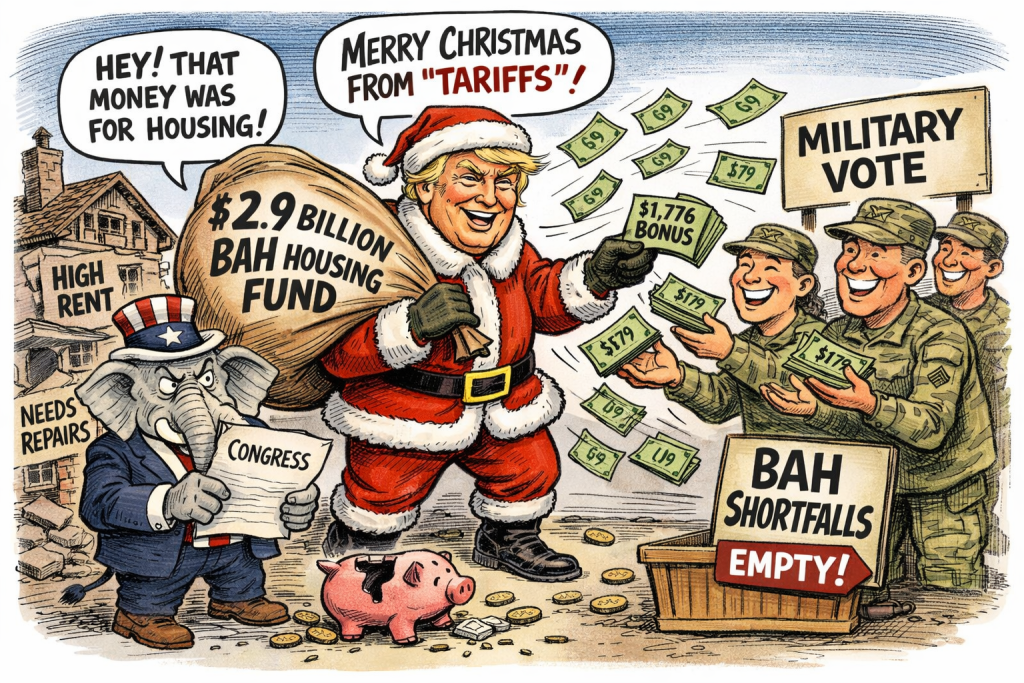
Even the Department of Defense has quietly walked back the president’s implication. Its public explanation states that funding for the Warrior Dividend was included earlier this year in the president’s “One Big Beautiful Bill,” appropriated by Congress as part of a $2.9 billion increase to the Basic Allowance for Housing (BAH). That statement improves on the president’s rhetoric, but it still avoids the central truth: this money was never intended to be a universal cash bonus.
Congress approved the $2.9 billion specifically to address chronic shortfalls in BAH, particularly in high-cost housing markets. The purpose was straightforward—to prevent military families from being forced to cover out-of-pocket housing costs in places where rents far exceed the standardized allowance. A service member stationed at Fort Lee, Virginia, faces a fundamentally different housing market than one stationed in Monterey, California. The appropriation was designed to reflect that reality.
Now consider the arithmetic. A $1,776 payment to 1,454,000 service members totals approximately $2.58 billion. Subtract that from the $2.9 billion BAH appropriation and roughly $318 million remains. In practical terms, nearly the entire fund Congress set aside to fix a known housing problem has been spent in one stroke, before it could be applied to the purpose for which it was justified and approved. What remains is a fraction of what lawmakers calculated was necessary—effectively leaving the underlying housing affordability issue unresolved.
The situation is compounded by a separate, smaller bonus of roughly $2,000 for about 45,000 Coast Guard personnel below the rank of captain, totaling around $90 million. That money will reportedly come from the Department of Homeland Security, from a funding source not yet clearly identified. It too is taxpayer money, regardless of the bureaucratic pathway used to distribute it.
None of this is an argument against supporting the men and women who serve. The issue is transparency, fiscal integrity, and respect for Congress’s power of the purse. Redirecting funds appropriated for one explicit purpose to another politically advantageous use, while mischaracterizing the source of those funds to the public, undermines trust in government. It also sets a troubling precedent: that carefully negotiated appropriations can be repurposed at will, so long as the outcome polls well.
The Warrior Dividend may feel like a gift, but it is not free, and it is not funded the way Americans were told. When leaders rely on half-truths to sell popular policies, the immediate applause often masks longer-term consequences. Military families still facing housing shortfalls will feel those consequences long after the holiday checks are spent.
Leave a Reply
You must be logged in to post a comment.